

How Did We End Up Owing a Greensboro Developer $52 Million? The Federal Decision Chain Behind the A&Y Greenway Lawsuit and What Every Midtown Neighbor Needs to Know
Let’s start with the thing that we quickly loose sight of:
The federal government is not some separate entity floating above us. It is not an abstraction. It is not "them." It is us. Every single dollar that passes through a federal agency is money that American workers earned, paid in taxes, and entrusted to people they elected and the agencies those people are supposed to oversee on our behalf. When a federal agency makes a decision that results in a $52 million court judgment, that $52 million comes out of our pockets. Yours. Mine. Your neighbor's. Your kid's future.
That is what is at stake in Greensboro right now.
A chain of decisions made over decades, some reasonable, some well-intentioned, some that in retrospect deserved a harder look, has resulted in a federal court ordering American taxpayers to potentially pay Greensboro developer Marty Kotis and his companies more than $52 million. The greenway along Battleground Avenue that so many of us walk and ride and love? We already paid Norfolk Southern approximately $8.5 million so the City of Greensboro could become the trail sponsor. And now, on top of that, the federal government, meaning us, may owe Kotis tens of millions more because of the specific legal mechanism used to create that trail.
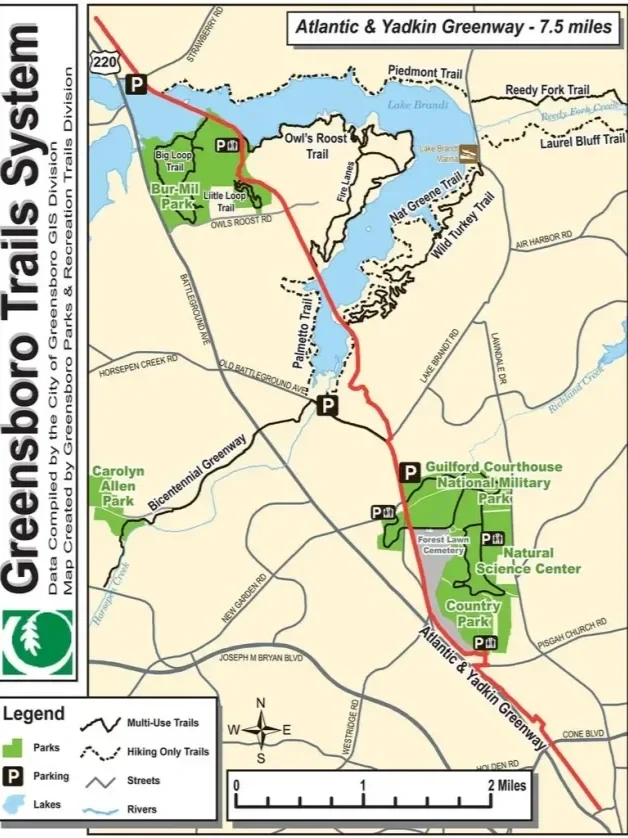
Atlantic and Yadkin Greenway shown in bottom right corner
Please note: The judgment is under appeal as of spring 2026. Nothing has been paid yet. But the clock is running and interest is accruing every day the case remains unresolved.
If that makes you want to understand exactly how we got here, step by step, so we can be more informed as a community going forward, you are reading the right post.
First: A Little History That Actually Matters
To understand the lawsuit, you have to understand the railroad. And to understand the railroad in Greensboro, you have to go back further than most people think.
On May 10, 1869, the completion of the first transcontinental railroad joined the Central Pacific and Union Pacific railroads at Promontory Summit, Utah. Work had begun in 1863 when the Central Pacific started laying track eastward from Sacramento while the Union Pacific pushed westward from Omaha. The fourth side of the ceremonial golden spike was engraved with words that captured the whole ambition: "May God continue the unity of our country as this railroad unites the two great Oceans of the world."
That iron road rewired American commerce and set off one of the greatest waves of rail construction the world had ever seen. Within decades, tracks were being laid across every region of the country, including deep into the Piedmont region of North Carolina, and directly through what would become Greensboro.
According to NCpedia , the North Carolina Railroad was chartered in 1849 and completed in 1856 from Goldsboro through Raleigh, Greensboro, and Salisbury to Charlotte, a distance of 223 miles. It was largely responsible for the Piedmont Urban Crescent that developed along its route, bringing into existence towns including Durham, Burlington, High Point, and Thomasville. The railroad was leased to the Richmond and Danville Railroad in 1871, and later to the Southern Railway Company for 99 years. Southern later merged with Norfolk and Western Railway to form Norfolk Southern.
According to the NC Department of Natural and Cultural Resources, the first rails were laid in Greensboro in 1851, and a local newspaper headlined the completion simply: "Finished!!"
The Atlantic and Yadkin Railway: Greensboro's Short Line
What is a short-line railroad? A short-line railroad is a smaller, independently operated freight carrier, typically classified as Class III under federal definitions. Short lines do the first and last mile work, linking local farms, factories, and mills to the national rail network. The A&Y hauled what the Piedmont produced: tobacco, textiles, timber, and granite.
According to Wikipedia's entry on the Atlantic and Yadkin Railway , the line operated within North Carolina from 1899 to 1950, running from Mount Airy southeast to Sanford and primarily serving the Piedmont region. Its roots traced back to the Cape Fear and Yadkin Valley Railway, which had been purchased in 1899 by the Southern Railway and reorganized under the A&Y name.
As reported by the Greensboro News and Record in 1915 the A&Y became an independent railroad with headquarters in a big brick building in downtown Greensboro behind the A&Y depot, freight yard, and roundtable. A long A&Y spur jutted from the main tracks at what is now Battleground Avenue and Hill Street and followed the edge of Latham Park to Cone Mills. That spur corridor is the same land that would later become the greenway at the center of the Kotis lawsuit.
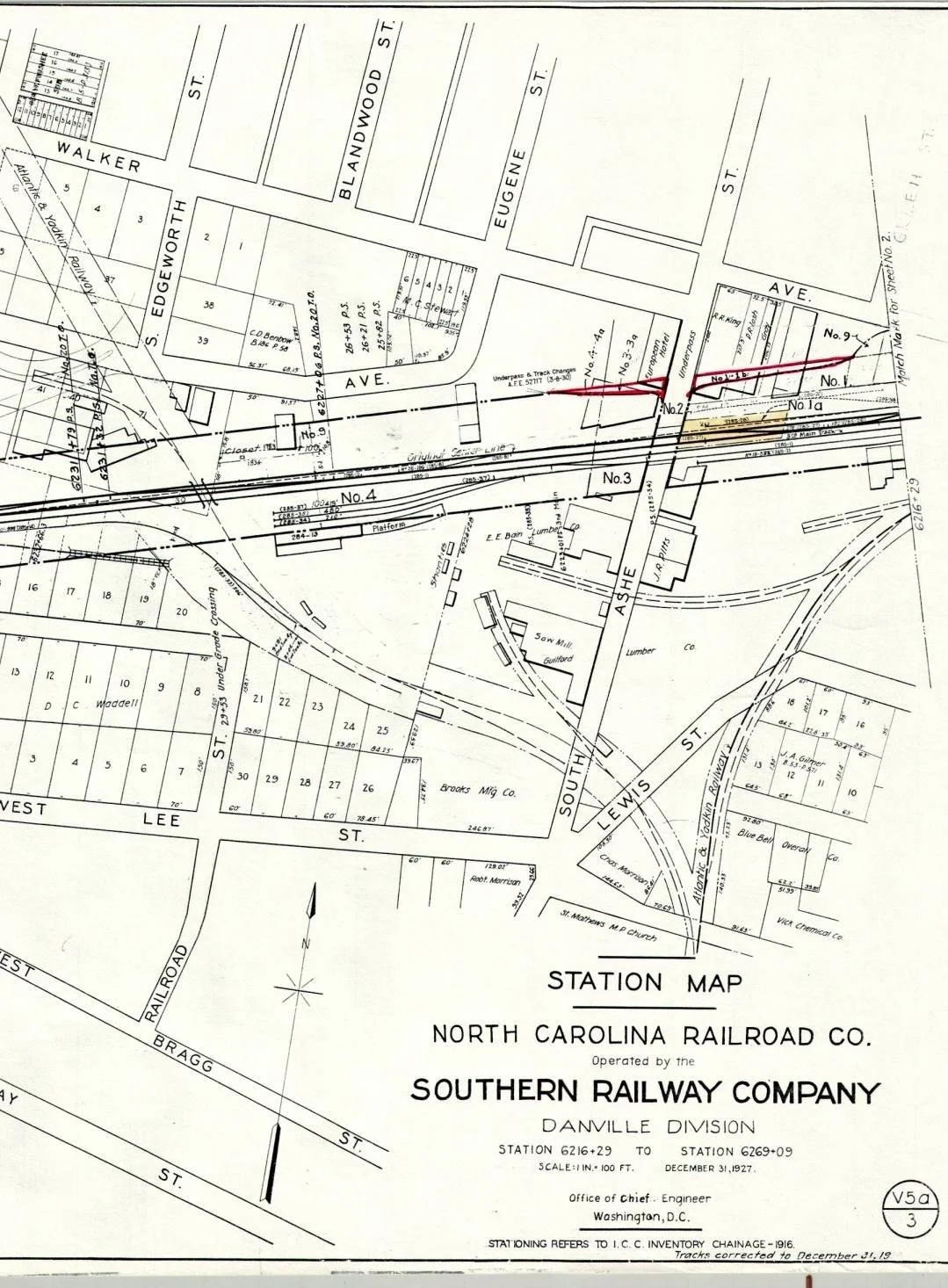
Maps shared on a FaceBook group Atlantic & Yadkin Railway History Serving the Piedmont in NC
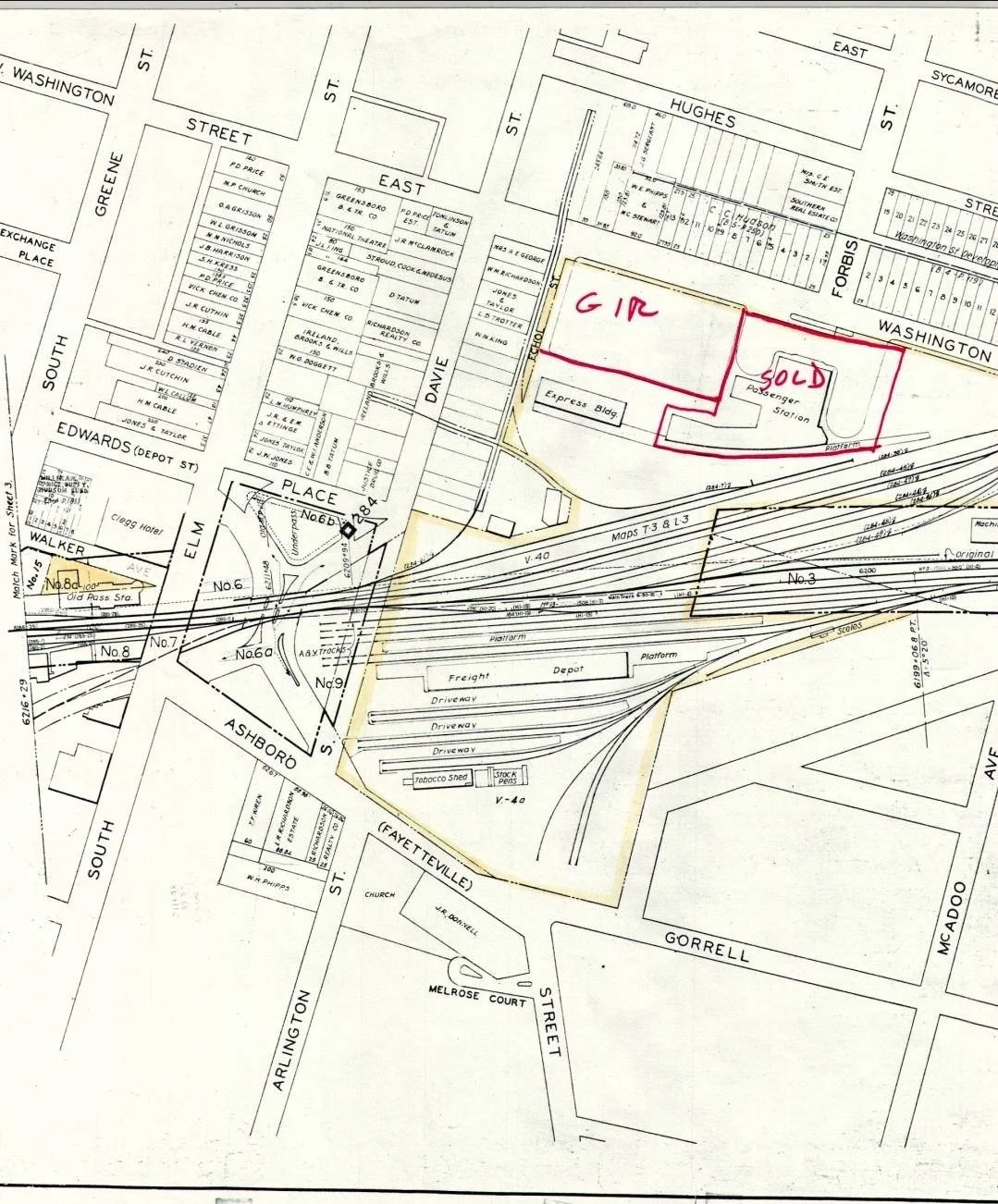
Maps shared on a FaceBook group Atlantic & Yadkin Railway History Serving the Piedmont in NC
The A&Y's downtown operations were anchored in the railroad district along South Elm Street. The Southern Railway Passenger Depot at 400 South Elm Street , built in 1899, still stands today and is listed on the National Register of Historic Places as part of the Downtown Greensboro Historic District. The A&Y headquarters building does not appear to have survived into the modern era with a documented street address, but 400 South Elm Street puts you in the same rail district where the A&Y operated for decades.
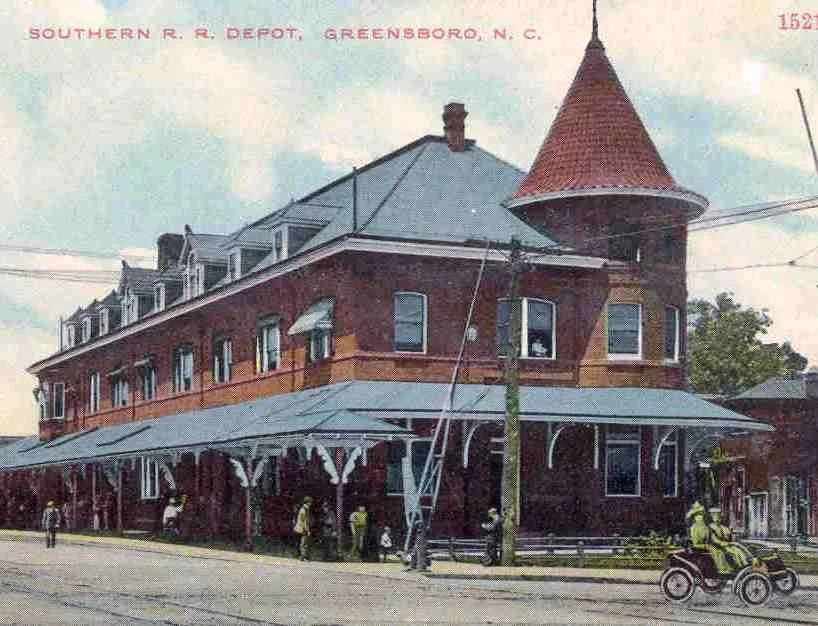
Southern Railway Passenger Depot
The A&Y's larger passenger operations were served by the station now known as the J. Douglas Galyon Depot at 236 East Washington Street, built in 1927. According to Great American Stations , the building was originally erected by Southern Railway to serve both itself and the A&Y. At its peak in the 1940s, more than 40 passenger trains came through the station daily. It is Greensboro's active Amtrak station today.
According to the Wikipedia entry on the Atlantic and Yadkin Railway , Southern Railway merged the A&Y into its own Winston-Salem Division effective January 1, 1950. At that time, the Atlantic and Yadkin Railway company ceased to exist.
According to the City of Greensboro Parks and Recreation Department, the Atlantic and Yadkin Greenway now runs along the abandoned rail bed through Greensboro. It is genuinely beloved. But the legal history of how its Midtown segment was created is where our $52 million problem begins.
Two Legal Concepts You Need to Understand Before Anything Else
Fee simple ownership means you own land outright, in full, with the right to use it, sell it, and pass it on. An easement is more limited: it is permission to use someone else's land for a specific purpose. When railroads were built across America, they often acquired easements rather than full ownership. The railroad had the right to run trains. The underlying landowner still technically owned the dirt beneath the tracks.
Under state property law in most states including North Carolina, when a railroad fully and formally abandons a corridor, that easement extinguishes. It disappears. The land reverts to the underlying fee owner, free and clear. That is what the property owners along the A&Y corridor expected would happen when Norfolk Southern walked away.
Then Congress changed the rules.
The Chain of Decisions That Created a $52 Million Judgment: Step by Step
Step 1: Congress Acts With Good Intentions (1983)
In the early 1980s, Congress grew concerned about the rapid disappearance of railroad corridors across the country. Lines were being abandoned, tracks were being pulled up, and land was reverting to private owners. Congress worried that if the nation ever needed those corridors again for transportation, they would be gone forever, fragmented into individual parcels impossible to reassemble.
So in 1983 Congress amended Section 8(d) of the National Trails System Act to create railbanking: a voluntary process allowing a railroad company and a trail sponsor such as a local government to agree that an out-of-service rail corridor would be used as a trail temporarily, preserving it for potential future railroad reactivation without triggering formal abandonment. The intent was reasonable: keep corridors intact, let communities use them as trails in the meantime, and maintain the option to reactivate rail service someday. What Congress did not fully account for was what this mechanism would do to the private property owners whose land lay beneath those corridors.
Step 2: The Legal Trap Hidden in the Statute
When railbanking happens, the railroad does not formally abandon the line. That means the easement does not extinguish. That means the underlying landowner does not get their land back as they would have under ordinary state property law. Instead, the federal government through an agency called the Surface Transportation Board issues a document called a Notice of Interim Trail Use, or NITU. The NITU defines the corridor width and transfers operational responsibility to the trail sponsor, imposing a new permanent public easement on the land of every underlying property owner within that footprint. Without their consent. Without compensation. Until they sue.
The Fifth Amendment Takings Clause says the government cannot do that without paying just compensation, meaning the fair market value of what was taken. The Supreme Court put it plainly in Armstrong v. United States (1960): the Takings Clause was designed to bar Government from forcing some people alone to bear public burdens which, in all fairness and justice, should be borne by the public as a whole.
The landmark case establishing this framework was Preseault v. United States, in which a Vermont couple whose land was subject to a railroad easement sued the federal government after their corridor was converted to a public recreational trail. Courts ultimately held they were entitled to compensation, establishing the precedent that a public recreational trail was not within the scope of an existing easement for railroad purposes. That ruling opened the door for hundreds of similar claims nationwide, including Marty Kotis in Greensboro.
Step 3: Norfolk Southern Decides to Walk Away (around 2019)
Norfolk Southern decided around 2019 that it no longer needed the 3.1-mile Midtown Greensboro segment of the former A&Y corridor. The City of Greensboro chose to step in as a trail sponsor and invoke the railbanking process, paying approximately $8.5 million to Norfolk Southern for the corridor rights. The STB issued the NITU. According to the case summary for Kotis Associates LLC v. United States, the NITU adopted a survey map depicting the right-of-way at up to 200 feet wide, meaning 100 feet on each side of the centerline. The trail was built. And the constitutional bill that Congress had baked into the process back in 1983 was handed to federal court.
Step 4: Marty Kotis Files Suit
According to the case summary for Kotis Associates LLC v. United States, the plaintiffs are Kotis Associates LLC, Kotis Holdings LLC, and Westover Terrace II LLC. The defendant is the U.S. Surface Transportation Board. The Kotis entities own 13 contiguous parcels that underlie or abut the 3.1-mile corridor. The affected commercial parcels span roughly 45 acres in Midtown, including properties at and near 1305 Battleground Avenue where the former Red Cinemas multiplex sat with the greenway running directly behind it, and the Westover Gallery of Shops at 1420 Westover Terrace. The owners sought just compensation of more than $44.7 million plus interest. The U.S. government conceded that a taking had occurred. The only remaining dispute was how much was owed.
Step 5: The Court Rules
As reported by FOX8 WGHP , in April 2025 a federal judge awarded the Kotis entities $52 million from the federal government. That money, if ultimately paid, would come from the federal Judgment Fund, a permanent appropriation administered by the U.S. Department of the Treasury that pays court-ordered monetary judgments against the United States. In plain language: you and me and every other American taxpayer.
As reported by FOX8 WGHP, the federal government appealed in November 2025. As of spring 2026, the appeal is pending at the U.S. Court of Appeals for the Federal Circuit. Interest continues to accrue on the judgment every day it remains unresolved.
A Note on Media Accuracy
When the judgment was announced, FOX8 WGHP reported the $52 million award as "believed to be the largest ever in a case over rails-to-trails land." The phrase "believed to be" is doing a lot of heavy lifting in that sentence. A basic search of public court records shows it is not accurate. According to the law firm Stewart, Wald and Smith, Haggart v. United States, resolved in 2021, resulted in a $177.4 million recovery for 254 landowners in King County, Washington, more than three times the Kotis award. The Kotis judgment is significant and may well be among the largest single-plaintiff awards in this area of law. But "largest ever" is not accurate, and "believed to be" is not research. It is the phrase reporters reach for when they have not checked the record. Sensational headlines move clicks. Verified facts take longer. This is exactly why you should read beyond the headline on anything that affects your neighborhood, your property values, or your tax dollars. We live here. We have skin in this game. We owe it to ourselves to know what actually happened.
Who Made Which Decision and What Could Have Gone Differently?
Congress in 1983
Congress wrote a law with legitimate national goals but built in a constitutionally expensive mechanism. The railbanking provision preserved corridors. But it did so by imposing new public easements on private land without immediate compensation, deferring the constitutional cost invisibly onto future taxpayers. Courts have consistently ruled that it is the federal government, not the trail group, railroad, or state or local governments, that must pay for Trails Act rails-to-trails conversions.
The City of Greensboro
The City chose to sponsor the greenway conversion, which gave us the A&Y trail. That decision benefits residents every single day. But trail sponsorship under the railbanking statute triggers federal takings liability for affected landowners, and whoever ultimately pays that liability, in this case federal taxpayers, were not sitting at the table when the City decided to move forward. Cities that pursue railbanking do not bear the constitutional cost themselves. That is a structural disconnect worth understanding in every community where a greenway conversion is being planned.
The Surface Transportation Board
The STB issued the NITU and defined the corridor at up to 200 feet wide. The DOJ's appeal specifically contests that width calculation, arguing the court's interpretation of the footprint was too broad and drove the compensation figure too high.
Kotis assembled commercial properties in Midtown over decades and had serious, documented development ambitions. As reported by FOX8 WGHP , his stated plan was to build nearly 50,000 square feet of retail, restaurant, and office space surrounding Red Cinemas, including rooftop terraces, great venues, and retail shops. As reported by the North State Journal , his company Kick Ass Concepts owns approximately one million square feet of retail properties in the Carolinas. The railbanking easement complicated and in some cases blocked that development. The legal system said his companies were owed compensation for that loss.
What Are Kotis's Plans for Our Midtown Neighborhood?
According to Business North Carolina , Kotis owns 45 acres in Midtown Greensboro along the Battleground Avenue corridor. His stated vision is a live, work, and play district with amenities including rooftop terraces, shops, and apartments along the greenway.
According to the North State Journal, current active projects for Kick Ass Concepts include a 10-acre mixed-use shops and lofts project in Midtown and an 11-acre entertainment and retail project centered on the former Brooks Lumber Company site at 302 West Gate City Boulevard, at the intersection of Gate City Boulevard and Eugene Street in downtown Greensboro.
The legal uncertainty has had real consequences in Midtown. A planned Publix supermarket at Westover Terrace was scrapped when the railbanking restrictions complicated construction and financing. In late January 2026, Red Cinemas, the last independently owned movie theater in Greensboro, announced it was closing permanently after more than 30 years.
According to the Greensboro News and Record, the city of Greensboro officially placed signs designating the Battleground Avenue corridor as Midtown, a designation Kotis said would help attract more retail to the area. According to Business North Carolina , his goal is to make Greensboro one of the top ten street-art destinations in the United States.
Kotis is not our adversary. He is a large-scale investor in the same neighborhood where many of us are also investors, whether through our homes, our rental properties, or our small businesses. His vision for density, mixed use, and trail-adjacent development aligns with what makes urban neighborhoods appreciate over time. The question worth asking is not whether to be suspicious of him but how we as a community engage with the planning process as his future projects move through the City.
What Can We Do Differently Going Forward?
This situation did not happen because anyone was corrupt or malicious. It happened because a federal statute created a mechanism with deferred costs, a city used that mechanism without full public accounting of its constitutional price tag, and individual property owners bore the burden until a court forced the public to pay.
When a rails-to-trails conversion is proposed in your community, ask your city council members directly: what is the estimated takings liability exposure? Has the City retained a property rights attorney to evaluate the NITU footprint? Who are the affected fee simple landowners, and have they been engaged before the NITU is issued?
When the federal government is acting through any agency and that action affects private property, the Fifth Amendment bill is always coming. The only question is when and how much. And the people who pay it are us.
How to Participate as a Neighbor and Taxpayer
Attend Planning and Zoning Commission hearings. According to the City of Greensboro, the Planning and Zoning Commission hears rezoning requests, conditional zoning districts, and annexations. Meetings are open to the public and you are entitled to speak. Planning Department: 300 West Washington Street, Greensboro, NC 27401. Schedule and agendas
Read public notifications before hearings happen. State law requires hearing notices published 10 to 25 days in advance. The City notifies all property owners within 600 feet by mailed notice. Make sure your mailing address is current with the Guilford County Tax Office so you receive these notices.
Check the City's online planning portal any time. Agendas, staff reports, and meeting videos are posted at greensboro-nc.gov/departments/planning/planning-zoning-agendas-minutes-videos . You do not have to wait for a mailed notice.
Connect with the City's Community Relations Office at 336-373-2723 to identify neighborhood groups and community leaders in areas affected by a development proposal.
Watch the Board of Adjustment too. Large redevelopment projects often require variance or Special Use Permit hearings in addition to standard rezoning. Both are public hearings where neighbors can testify. Details at greensboro-nc.gov/departments/planning/boards-commissions-meetings .
Connect With Your Midtown Area Neighborhood Associations
Several active, organized civic groups operate in the neighborhoods surrounding the Battleground Avenue corridor. If Idlewood does not yet have a formal neighborhood association, neighborhoods without organized civic voices are consistently the last ones heard in planning processes. The City's Community Relations Office at 336-373-2723 is the right starting point.
Westerwood Neighborhood Association Serves the historic Craftsman bungalow neighborhood directly adjacent to Midtown. Contact: info@westerwoodneighborhood.com | westerwoodneighborhood.com
Fisher Park Neighborhood Association Monthly board meetings at 6:30 p.m. at Temple Emanuel off Florence Street. Text FPNA to 336-203-7773 for alerts. P.O. Box 2004, Greensboro, NC 27402 | fisherparknc.org
College Hill Neighborhood Association Greensboro's oldest neighborhood, immediately south of the Midtown corridor. Member of the Greensboro Neighborhood Congress (https://collegehillgreensboro.net/association/greensboro-neighborhood-congress), which meets every other month on the second Saturday at the Greensboro Public Library Central Branch, 219 North Church Street. | collegehillgreensboro.net
Related Posts on Joy Watson Real Estate
What Kotis, Zimmerman, and Carroll Are Building and How It Touches Midtown Idlewood
What's Happening with Greensboro's Big Three Developers: Kotis, Carroll, and Zimmerman
Greensboro's Big Three Developers: Money, Influence, and Public Record Questions
Midtown's Renaissance: Marty Kotis' $52 Million Victory and Our Idlewood Life
Glossary of Key Terms
Short-line railroad — A smaller, independently operated freight railroad, typically Class III under federal definitions. Provides first and last mile service connecting local shippers to national rail networks.
Fee simple ownership — Complete, outright ownership of real property with no conditions. The owner holds the land and can sell it, lease it, or pass it on.
Easement — A limited right to use another person's land for a specific purpose. Railroad easements gave carriers the right to operate trains without conveying full ownership of the underlying land.
Railbanking — A federal mechanism established in 1983 allowing an out-of-service railroad corridor to be converted to trail use temporarily without triggering formal abandonment, keeping the corridor available for future rail reactivation.
Surface Transportation Board — The federal agency that regulates railroad abandonments and railbanking approvals.
Notice of Interim Trail Use or NITU — The federal order issued by the STB that initiates railbanking, establishing the corridor width and transferring responsibility to a trail sponsor.
Takings Clause — The final clause of the Fifth Amendment prohibiting the federal government from taking private property for public use without just compensation.
Just compensation — The fair market value owed to a property owner when the government takes their property.
U.S. Court of Federal Claims — The specialized federal court that hears monetary claims against the United States government, including Fifth Amendment takings cases.
Judgment Fund — The permanent appropriation administered by the U.S. Treasury that pays court-ordered monetary judgments against the United States. That means taxpayers.
If you are thinking about buying, selling, or investing in Midtown Greensboro, the Idlewood neighborhood, or anywhere along the Battleground Avenue corridor, I would love to talk through what any of this means for a specific property. Visit our Preferred Vendors page or browse the full Joy Watson Real Estate Blog for more on local market conditions, neighborhood history, and the investment landscape across the Piedmont Triad.
Joy Watson, Realtor® | Joy Watson Real Estate Serving Greensboro, NC and the Piedmont Triad (928) 699-8883 | joy@joywatsonrealestate.comjoywatsonrealestate.com (https://www.joywatsonrealestate.com) License #307423 | Firm License #C37131 Equal Housing Opportunity 🏠