
This graphic showed up in front of me on Facebook this week. Big red and blue letters, three numbered boxes, and a bottom line telling me how to vote. It is exactly the kind of post that made me delete Facebook from my phone. It looks official. It cites bill numbers. And by the time you scroll past it, you feel like you know something.
Some of it is right. Some of it is opinion presented as fact. And a few important things are missing entirely. I covered the property tax amendment in July and the Guilford sales tax in Nickel on a Twenty in August, so consider this the update: the graphic itself, the holes in it, and every question on a Guilford County ballot for Tuesday, November 3, 2026, in plain English. The candidates have their own post.
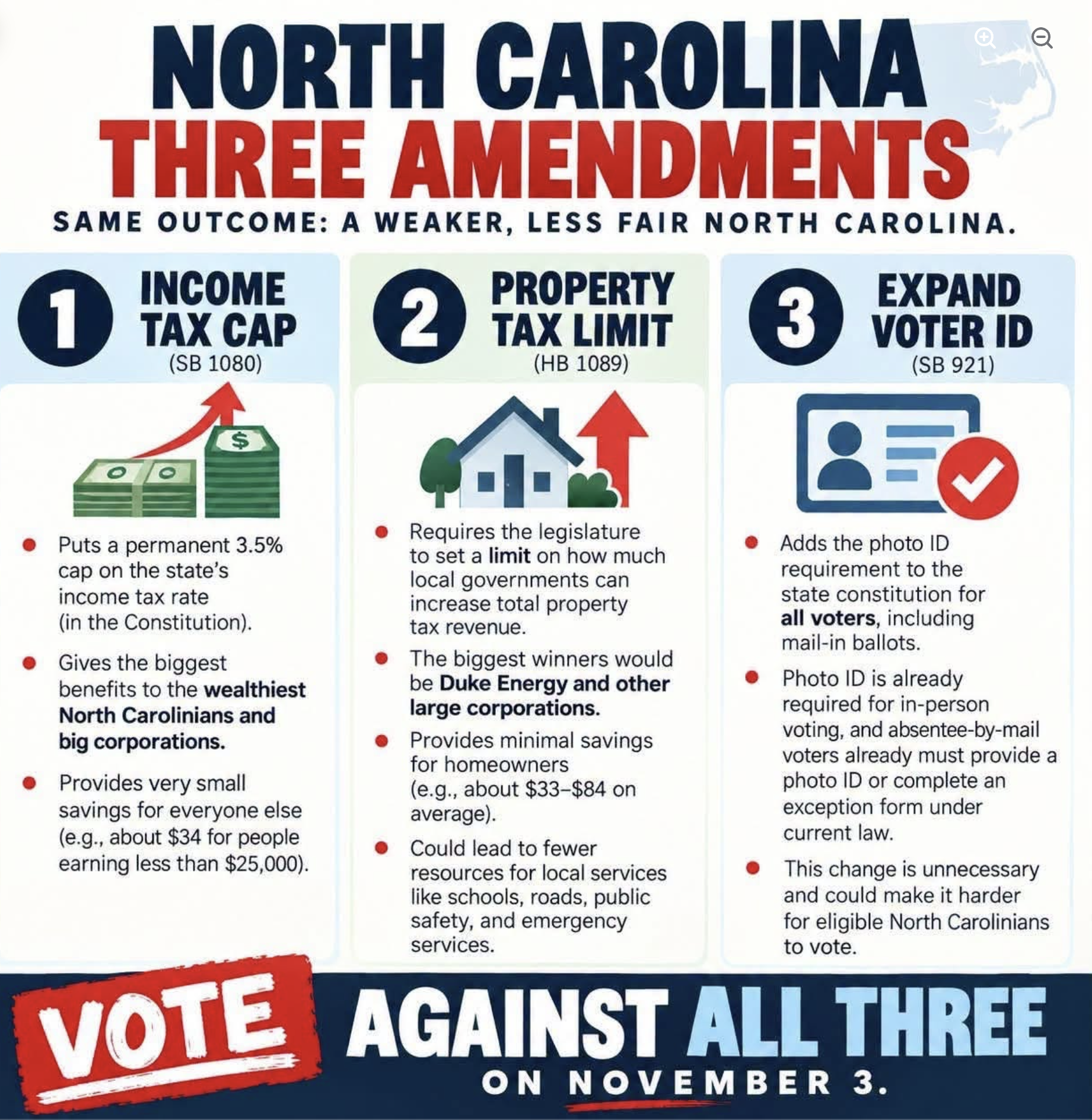
The graphic as it circulated on Facebook in October 2026, shared here for commentary. The copy I saw was posted by a personal profile, not a campaign, and it carries no name and no "Paid for by" line, so there is no way to tell who designed it or who, if anyone, paid for it.
What the graphic gets right
Credit where it is due. The bill numbers are correct. The income tax cap is Senate Bill 1080, the property tax limit is House Bill 1089, and the voter ID amendment is Senate Bill 921. It correctly says the property amendment only requires the legislature to set a limit later. And it correctly describes current voter ID law: under G.S. 163-230.1, people voting by mail already send a copy of their photo ID or an exception form with their ballot.
So it is not made up. That is what makes it effective, and what makes the gaps worth pointing out.
Hole 1: The income tax amendment does not cut anyone's taxes
The graphic says the 3.5% cap gives about $34 to people earning under $25,000 and the biggest benefits to the wealthiest. Here is what it leaves out. North Carolina's income tax rate is 3.99% in 2026, and a separate law, S.B. 257, signed July 7, 2026, already drops it to 3.49% for 2027 through 2029, then lower after that. That cut happens whether this amendment passes or fails.
So any dollar savings belong to S.B. 257, not to the amendment. What the amendment actually does is shrink the ceiling in the North Carolina Constitution from 7%, which voters approved in 2018, to 3.5%. After that, no future legislature could set any income tax rate above 3.5%, including a higher bracket for top earners, without another statewide vote.
That is the real debate, and it is a fair one. Supporters say it locks in tax relief and gives people certainty. Opponents say it ties the hands of future lawmakers during a recession or emergency, and that the people a future top bracket would have reached are the ones the cap protects. During the Senate debate, Republicans tabled a Democratic proposal to exempt the top 1% of earners from the cap. You can weigh that either way. The graphic just skips it.
One more small hole: the graphic names "big corporations" as winners. North Carolina's corporate income tax is already being phased out under existing law, so the cap changes little for them.
Hole 2: The property tax amendment has no number in it
The graphic says Duke Energy and other large corporations would be the biggest winners and homeowners would save about $33 to $84. Those figures trace to a study by the NC Housing Coalition, which tested what a 2% limit would have done during each county's last revaluation. It is a useful study, from a group that opposes the amendment. But the amendment does not say 2%. It does not say any number. The full new sentence reads that the General Assembly "shall enact general laws limiting the amount by which the levy of taxes on property may increase, which may include exceptions." The actual limit, and who wins or loses under it, gets written after you vote.
Here is the part I would want every homeowner to understand, because it trips people up. A levy limit caps the total dollars a city or county collects, not your individual bill. If your home's value climbs faster than your neighbors' at the next revaluation, your bill can still go up. If you lived through Greensboro's 2026 budget fight, you know how much the details matter.
Supporters point out that 22 states already have local levy limits and say they give owners predictability. Opponents, including House Democratic Leader Robert Reives, counter that the legislature can already limit property taxes without changing the constitution. Both points are on the record. The graphic gives you one.
The property tax amendment, in examples
This is the one that confused me most, so here it is with numbers. One warning first: North Carolina has never had a levy limit, and lawmakers have not written ours yet, so the North Carolina numbers below are made up to show how the idea works. They are not a prediction.
Example 1: a real levy limit that has run for decades
Massachusetts has used one since 1980, called Proposition 2½. A town's total property tax collections can grow 2.5% a year, plus extra for new construction. Rising values from a revaluation do not count as growth. If a town wants more than that, it has to ask its voters in an "override" election. The small town of Dunstable did exactly that: it asked voters for $480,841 more, which its own handout says would add about $384 a year to the average home's bill. In that system, a big jump in property taxes becomes a question on the ballot instead of a vote by the town board.
Example 2: what a cap on collections looks like (made-up numbers)
Say a county collects $100 million in property taxes this year, and lawmakers set the limit at 3%, with new construction exempted. Next year the county can collect up to $103 million from existing property, plus whatever the new houses and buildings add, no matter how much values rose. North Carolina already makes counties publish a "revenue-neutral" rate after every revaluation, the rate that would bring in the same money as before, under G.S. 159-11(e). Today that number is information only. A levy limit would turn something like it into a hard ceiling.
Example 3: why your own bill can still go up (made-up numbers)
A levy limit caps the county's total, not your house. After a revaluation, values across the county rise 35% on average. To stay inside a 3% cap, the county has to lower the tax rate. Now look at two neighbors who each paid $3,000 last year:
| Home | Value change | Last year's bill | New bill under a 3% cap |
|---|---|---|---|
| Home A | Up 50% (faster than average) | $3,000 | About $3,433 (up $433) |
| Home B | Up 20% (slower than average) | $3,000 | About $2,747 (down $253) |
Same county, same cap, opposite results. The cap protects the total, and the burden shifts toward whatever property is gaining value fastest. Whether that lands on homes, apartments, farmland, data centers, or power plants depends on the market, and on the exceptions lawmakers write.
Questions to ask yourself before you vote
Who do you trust to write the rule? A yes vote hands the details (the percentage, and what counts as an exception) to the General Assembly in Raleigh. A no vote leaves property tax rates where they are now, set by your county commissioners and city council, the people you can call and vote out locally.
What would the exceptions be? School construction debt, voter-approved bonds, and emergencies are common exceptions in other states. None are promised here.
Do you want big increases to go to a public vote? That is the strongest case supporters make, and Massachusetts shows how it can work. The strongest case opponents make is that local services lose money when costs rise faster than the cap.
Hole 3: "Unnecessary" is an opinion, not a fact
On voter ID, the graphic's own second bullet admits that mail-in voters already provide ID or an exception form. What the amendment changes is where that rule lives. Today the constitution only requires photo ID for in-person voting, and the mail-in rule sits in ordinary state law, which any future legislature could loosen. The amendment moves it into the constitution for every voting method.
Whether that is unnecessary or a sensible safeguard is a judgment call. Reasonable people land on both sides. The graphic states its side as a fact and says the change "could make it harder" to vote without saying how.
Can someone copy another person's ID and vote their mail ballot?
This was my first question too. The short answer: a photocopy of an ID cannot prove the person holding the pen is the person on the card. Nobody at the elections office sees the voter's face. That is a real limit of the copy requirement, and it is fair to say so. The ID copy is one layer. Here are the others North Carolina uses, from the State Board of Elections and the statute itself:
Getting a ballot in the first place. Ballots only go to registered voters who request one, and the request needs the voter's date of birth plus a driver's license number or the last four digits of a Social Security number, which officials check before mailing anything. Faking a request is a felony.
Two witnesses or a notary. The voter marks the ballot in front of two adult witnesses or a notary, who sign the envelope saying they watched that voter do it. Forged witness signatures were part of the criminal charges in the case below.
Who may touch a ballot. Under G.S. 163-226.3, only the voter, a near relative, or a legal guardian may take possession of a mail ballot to return it. Anyone else holding someone's ballot is committing a Class I felony. There are no drop boxes in North Carolina, and county offices log who drops off each ballot.
Care homes. The same law bars owners, managers, and employees of hospitals, clinics, nursing homes, and rest homes from requesting ballots for residents, marking them, helping mark them, or signing as witnesses. Residents without family to help can ask the county for a multipartisan assistance team, at least two trained volunteers that must include both major parties, so no single side is alone in the room. One gap worth naming: group homes for younger adults are not listed by name in that section, so there the general rules apply (family or guardian help, the ban on anyone else handling the ballot, and the felony penalties).
After it arrives. A bipartisan county board reviews every envelope, a voter whose ballot is accepted cannot vote again in person, ballots must arrive by 7:30 p.m. on Election Day, and voters can track their ballot through BallotTrax. Since September 2026, if an official has first-hand information that an unauthorized person returned a ballot, that ballot is canceled and the voter gets a new one. The state's own list of safeguards does not include comparing signatures.
Has it happened here?
Yes, and it is the reason many of these rules are as strict as they are. In 2018, a paid operative in Bladen County ran crews that collected absentee ballots, filled some in, and forged witness signatures in the 9th Congressional District. The State Board refused to certify the result, held public hearings, and unanimously ordered a new election in February 2019, and the people involved were criminally charged. The scheme happened, and it was caught. Both halves of that story are true.
What the amendment would and would not change
Every safeguard above already exists in state law. The amendment does not add a new one. It moves the photo ID requirement for mail voting into the constitution, so a future legislature could not drop it with an ordinary bill. If you think the ID copy is an important layer that should be locked in, that is the case for a yes. If you think the real protection comes from the witness, possession, and care-home rules, and the copy adds a hurdle without much protection, that is the case for a no.
Would this stop the fraud North Carolina has actually found?
There is a lot of national news about voter fraud, so I looked at what North Carolina has documented here. The clearest breakdown is the State Board of Elections' audit of the 2016 general election, which found 508 ineligible votes out of about 4.8 million cast, roughly 1 in every 9,400:
| What happened | Cases | Would a photo ID stop it? |
|---|---|---|
| Voting while still serving a felony sentence | 441 | No. The voter shows their own real ID. Caught by checking rolls against court records. |
| Noncitizens voting | 41 | Mostly no. A driver's license proves who you are, not citizenship. Caught by citizenship checks. |
| Voting twice | 24 | No. Same person, same ID. Caught by matching voter histories, including across states. |
| Absentee ballots filled out for relatives who had died | 2 | Possibly. This is the kind of case an ID copy is aimed at. |
| Someone pretending to be another voter at the polls | 0 | This is what photo ID is designed to stop. |
Across 2015 through 2020, the State Board referred seven impersonation cases for prosecution statewide. And the biggest fraud case in recent state history, the 2018 Bladen County scheme described above, involved people collecting real voters' ballots. ID copies would likely have been collected right along with them. What caught it was the rule against anyone outside the family handling a ballot, plus investigators who noticed the absentee numbers did not add up.
So the fair answer is that photo ID targets the rarest kind of fraud found here. The more common problems get caught by checking voter rolls against court, citizenship, and other states' records, and by enforcing the ballot-handling rules. Supporters make a reasonable case that ID discourages people from trying in the first place and raises public confidence, and that locking it into the constitution keeps it from being dropped later. That is a case about prevention and trust. It is not a fix for the loopholes North Carolina has actually seen used.
When a news story says fraud is happening, ask three questions: which kind, how many cases, and in which state. The answer tells you which fix would actually help.
Hole 4: It skips questions on your ballot
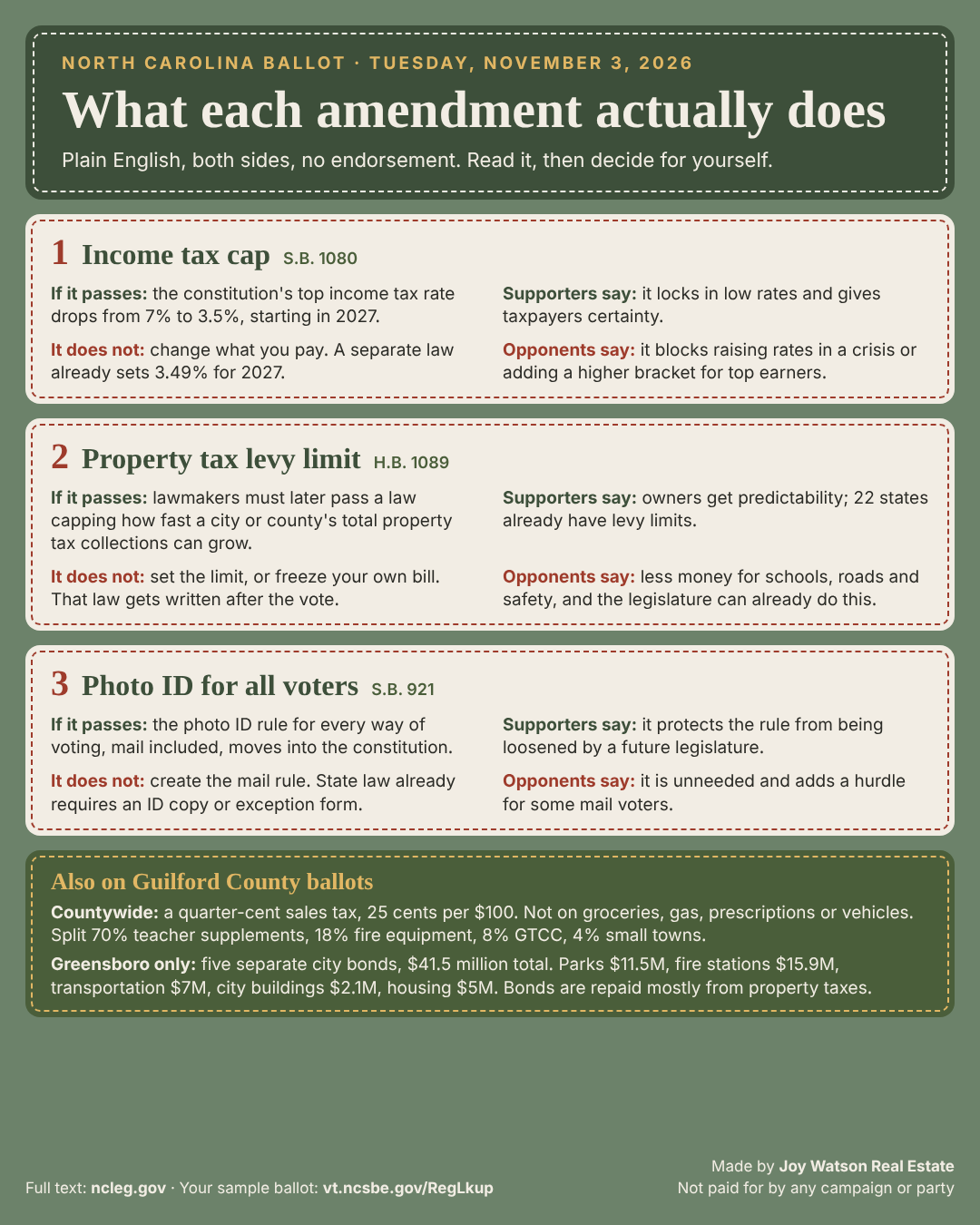
If you live in Guilford County, you will see at least four questions, not three. If you live inside Greensboro city limits, you will see nine, because the city has five bond questions too (covered below). On August 6, the Board of Commissioners voted to place a quarter-cent sales tax on the November 3 ballot, split 70% teacher supplements, 18% fire equipment, 8% GTCC, and 4% qualifying towns. That is 25 cents more per $100 of eligible purchases, and it would not apply to groceries, gas, prescriptions, or vehicles. I walked through the fine print on that one in August, including how the legal definition of "classroom teacher" changed before a single ballot was printed.
Hole 5: No name, no "Paid for by"
The graphic does not say who made it. Paid political ads on Facebook have to carry a "Paid for by" label, and every one of them stays searchable in the Meta Ad Library for seven years. But when someone screenshots an ad, saves a graphic, or reposts it from a personal page, the label does not travel with it. The message keeps working, and the people who paid for it disappear. Whether anyone planned it that way or not, the effect is the same: the money stays hidden.
I traced this one. The copy I saw was posted by an individual's personal profile, and I found no paid ad using this exact image. The same "vote against all three" message is running as a paid ad, labeled as paid for by the North Carolina Democratic Party, with different artwork. In my Ad Library searches on October 8, most paid Facebook ads about these amendments came from groups urging a no vote. Facebook is only one channel; TV, mail, and other platforms do not show up there.
So here is the rule I am using now, and I would suggest it to anyone: a political post with no name and no "Paid for by" line is an opinion from a stranger who may have a paid agenda you cannot see. It is not your friend's opinion, even when your friend shared it. Your friend is passing along a message somebody else built, and that somebody may have money riding on how you vote.
That goes for every side. Candidates and parties of every stripe take money from corporations, trade groups, and special interests, and the slogans they put on the ballot are written to move you. You can see who funds each candidate in the State Board of Elections campaign finance search. Holding them accountable starts with knowing who is paying them.
The other side's slogans have holes too
This is not a one-sided problem. The income tax amendment's official short name is "Lower Taxes for All NC," yet as covered above, the amendment itself lowers no one's taxes. House Speaker Destin Hall said the levy limit amendment would "stop runaway property tax hikes," but the amendment sets no limit on its own; that depends on a law not yet written. Slogans are built to move you, from either direction.
The four tax and ID questions in plain English
| Question | A FOR vote would | It would not |
|---|---|---|
| Income tax cap (statewide) | Lower the constitution's maximum income tax rate from 7% to 3.5%, starting with 2027 tax years | Change the rate you pay; the 2027 rate of 3.49% is already set by S.B. 257 |
| Property tax levy limit (statewide) | Require the legislature to pass a law capping how fast local property tax collections can grow | Set the cap, or guarantee your own bill stays flat |
| Photo ID for all voters (statewide) | Put the photo ID rule for every voting method, including mail, into the constitution | Create the mail-in ID rule; that already exists in state law |
| Quarter-cent sales tax (Guilford only) | Add 0.25% to sales tax, split among teacher supplements, fire equipment, GTCC, and small towns | Apply to groceries, gas, prescriptions, or vehicles |
For context, an Elon University Poll taken in late August found likely voters favoring all three amendments, with 65% for photo ID, 68% for the income tax cap, and 71% for property tax limits. Popular and well understood are not always the same thing.
Greensboro only: five city bond questions
If you live inside Greensboro city limits, you will also vote yes or no on five separate bonds totaling $41.5 million. A bond lets the city borrow the money and repay it over time, mostly from property taxes, so each one is a decision about future tax dollars. Each question stands alone; you can approve some and reject others. Amounts and project lists come from the City of Greensboro's 2026 bond page, which also links the city's full information booklet.
| Bond | Amount | What the city says it pays for |
|---|---|---|
| Parks and recreation | $11.5 million | Facility improvements ($2.5 million), Bingham Park remediation ($5 million), land and park improvements ($4 million) |
| Firefighting facilities | $15.9 million | Knox Road and Burlington Road station ($10.9 million), Fire Station 49 on Friendly Avenue renovation ($5 million) |
| Transportation | $7 million | Bridge replacement ($2 million), bridge maintenance ($3 million), Bus Rapid Transit ($2 million) |
| General facilities (municipal buildings) | $2.1 million | Brick facade wall repair ($1.5 million), ADA upgrades ($600,000) |
| Housing | $5 million | Permanent supportive housing |
Who is on the ballot
The candidates got their own post: Every Candidate on Guilford County's November 2026 Ballot, in Their Own Words. It lists all 40 races and 68 candidates, with a link to what each candidate puts out themselves.
How I check a political post before I believe it
Read the bill. Every amendment's full text is free on the North Carolina General Assembly site. These are short. The property tax one is two sentences.
Read the official explanation. State law, G.S. 147-54.10, requires a plain-language explanation of every amendment at least 75 days before the election. Your county board of elections has a copy.
Ask who is talking. Look for a "Paid for by" line and search the Ad Library. No name means a stranger with an agenda you cannot see, not a friend's opinion.
Trace every number. Ask what the number is measuring and whether it describes this amendment or something else. That one question would have caught Hole 1.
See your actual ballot. Look up your registration and sample ballot through the NC State Board of Elections voter search.
Why I bothered
I deleted Facebook from my phone because posts like this one left me more confused, not less, and I read ballot language for fun. If it wears me out, I can only imagine how it lands for someone working two jobs and scrolling at a red light. Taxes on property, income, and purchases are part of what it costs to own a home or run a rental here, so this is squarely my business at Joy Watson Real Estate. My job is to inform, not to tell you how to vote. Read the words, check the numbers, and vote however you decide.
Keep reading: Every Candidate on Guilford County's November 2026 Ballot
Keep reading: Nickel on a Twenty: Guilford County's Eighth Sales Tax Vote Is Set for November 3
Keep reading: Two Tax Questions on Guilford County's November 2026 Ballot
Keep reading: Guilford County's Sales Tax Referendum and the Classroom Teacher Definition
More local coverage: the Joy Watson Real Estate blog
Joy Watson Real Estate is an independent, non-corporate brokerage in Greensboro, NC. Joy Watson is a licensed North Carolina real estate broker (Broker-in-Charge). Questions about buying, selling, or renting in the Triad? Reach out through JoyWatsonRealEstate.com.
This post is general information, not legal, tax, or financial advice. Talk to your attorney, CPA, or lender about your situation.